
Budapest, March 5, 2026. – Based on the Minerva Institute's survey conducted between February 20-25, 2026, which is representative of the Hungarian adult population in terms of gender, age, education, and settlement type, electoral participation willingness remains exceptionally high, while party preferences and assessments of individual candidates clearly demonstrate Tisza's advantage. More than half of respondents believe that the election campaign is being influenced from abroad, though there is strong disagreement about who the supposed interferors are.
The survey results show that participation intention is near record levels. 89% of respondents said they would definitely or probably participate in the election. According to the Minerva Institute's interpretation - even accounting for the possible effect of overrepresentation of politically more active respondents typical in such measurements - it can be assumed that record-breaking participation of over 70% is likely. Mobilization is strong among committed voters: based on their answers, neither bad weather nor long lines would deter them, with nearly two-thirds (63.5%) planning to vote in the morning, and a similar proportion intending not to vote alone (61.2%). The vast majority of respondents have already received their ballot notification (84%). 94% of those promising to participate definitely or probably know exactly where to vote, and only about 5% indicated they would vote somewhere other than their permanent address.
In the party competition, Tisza's advantage in the Minerva measurement continues to be significant. A 9 percentage point lead is visible among committed voters with party preference, and a 6 percentage point lead in the full population, while the proportion of "don't know" answers in the party choice question is 22% - however, the profile of the undecided/evasive voters is overall somewhat more identifiable as potential Tisza voters.
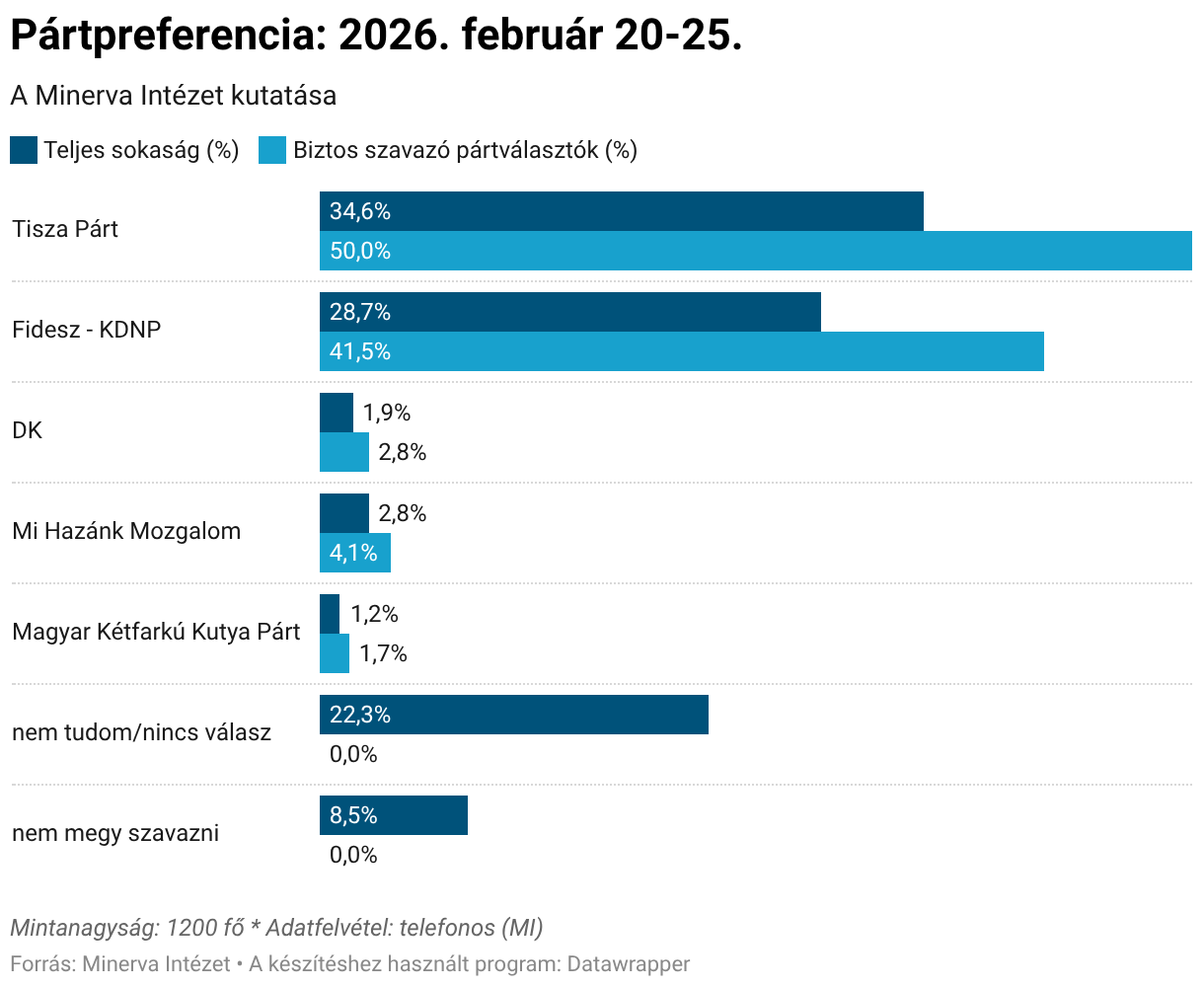
Among smaller parties, Mi Hazánk's situation appears the most acute: according to the Institute's measurement, they are the only ones who could reach the 5% threshold - from above or below, but very close to it.
In the individual candidate competition, Tisza's advantage is 7.5 percentage points. However, the survey also points to a pattern important for the campaign: among party-list supporters, there are 8 percentage points fewer Fidesz supporters backing the Fidesz candidate than Tisza supporters backing the Tisza candidate. Additionally, there is a somewhat higher proportion of undecided and evasive voters in the individual candidate question. Overall, 29% of respondents said they would vote for the Fidesz candidate, 43% support another party's candidate or an independent, while the rest have not yet decided.
The Minerva Institute regularly asks whether respondents would like Viktor Orbán to remain Prime Minister for another four years. The proportion answering "no" has continuously increased compared to previous measurements, and is now 8 percentage points higher than those who would support Orbán's continuation.

Similarly, a regular question asks which party the respondent predicts will win; on this measure, Tisza currently leads by 2 percentage points, indicating that a perceptible shift has occurred at the level of expectations.

Based on the composition of the group of undecided and evasive voters, the Minerva Institute observes that in this circle, potential Tisza voters are somewhat more identifiable as a proportion than respondents leaning toward other political sides. This finding, alongside the high proportion of "don't know" answers, makes the mobilization and persuasion effects of the next period's campaign particularly important.
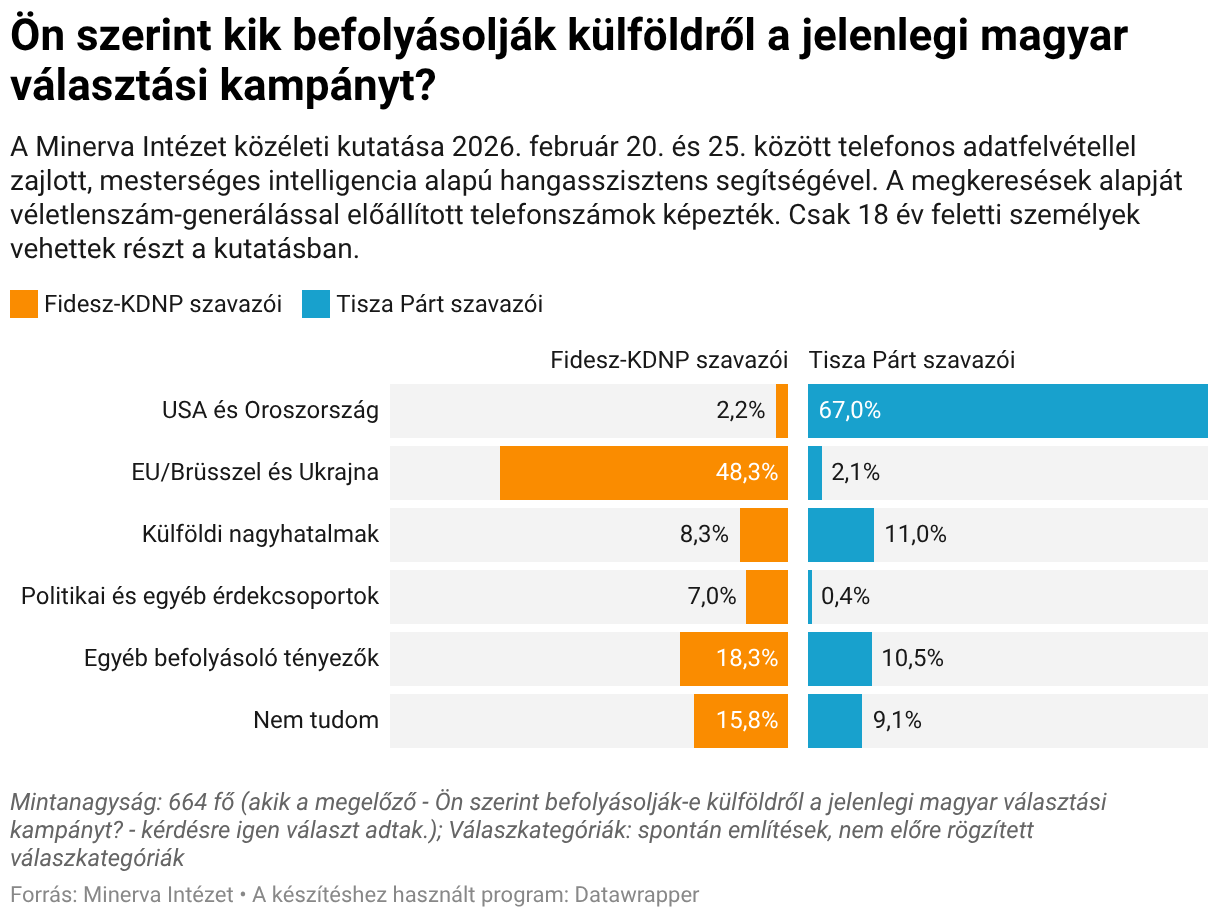
On the question of foreign influence on the campaign, approximately 55% of respondents believe the election campaign is being influenced from abroad. While this is a high value in itself, there is marked disagreement about naming the possible interfering country or power. Responses aligned with the government narrative - the EU/"Brussels" and Ukraine - are overall in the minority (23.2%), though they count as dominant opinion in the Fidesz camp. In parallel, government-opposing voters predominantly identify Russia and the United States as supposed sources of interference. Those uncertain about party choice mostly do not take a position on this question either, but a slight majority in their circle holds the opposition view.
The Minerva Institute conducts telephone public opinion surveys using automated artificial intelligence voice assistants. The survey conducted between February 20-25 was conducted as an independent research institute without a client, pursuing its own professional goals. The survey collected a total of 2,475 fully completed questionnaires, from which a representative sample of 1,200 respondents was randomly selected through quota sampling (simulation optimization procedure) for age groups.
Following the Minerva Institute's updated research methodology, the February measurement results are determined through weighting based on the KSH's 2022 census data: during weighting, we adjust the sample to known population joint distributions by gender, age, settlement type, and education level, taking into account mortality rates during the intervening period and changes in education levels. Detailed methodological description is available at this link.
The survey can be further analyzed freely:
▶ Questions
▶ Response database (XLSX)
▶ Analysis results (XLSX)
▶ Research methodology